Learn
The EU two-year guarantee and a manufacturer's warranty
When something you bought breaks, you may have two kinds of protection: the legal guarantee every shop in the EU owes you, and the warranty the maker or shop chose to add. They are not the same thing, and the first one exists even if no one mentions it.
This page sums up the EU rules as the European Commission's Your Europe site explains them (read on 1 November 2026). It is not legal advice. Greek and Cypriot law may give you more; for your own case, ask the seller, a consumer body or a lawyer.
On this page
1. Two different things
Legal guarantee
- Given by the seller, because the law says so
- At least two years from when you receive the goods
- Covers goods that are faulty, or don't look or work as advertised
- Always applies, whether anyone mentions it or not
Commercial warranty
- Given by the shop or the maker, by choice
- Lasts as long as its terms say
- Covers what its terms say
- Can add to the legal guarantee, never reduce it
2. What the legal guarantee gives you
- If goods are faulty or don't look or work as advertised, the seller must repair or replace them at no cost.
- If that is impossible, or can't be done in a reasonable time and without significant inconvenience, you can ask for a full or partial refund.
- For a fault that shows up within one year of delivery, you don't have to prove it was there at delivery; in some EU countries this period is two years.
- Second-hand goods bought from a business are covered too; some countries allow a shorter period to be agreed, but not under one year, and it must be made clear when you buy.
- Goods bought from a private person are not covered by these rules.
- Some EU countries have a longer legal guarantee than two years.
3. What to keep
- The receipt or invoice, which shows what, where and when.
- The delivery note or the date it arrived, since the two years start on delivery.
- The warranty card or statement, if there is one, and its end date.
- The model and serial number, and a photo of the item and its label.
- Your emails or messages with the seller about the fault.
Receipts printed on thermal paper fade, so photograph them the day you buy.
4. If you lost the receipt
The Your Europe page doesn't say what proof of purchase you need. In practice, a seller wants to see that you bought the item from them and when. A card or bank statement, an order confirmation or e-invoice, your account or loyalty card history with the shop, or the box with the serial number may help. Ask the seller what they will accept, and keep a copy of whatever you show them.
5. How to ask for it
- Go back to the seller, not the maker: the legal guarantee is the seller's.
- Describe the fault in writing, by email or a letter, with the date of purchase and a photo.
- Ask for a repair or a replacement. Keep copies of everything you send and receive.
- If you get nowhere, ask your national consumer body; in Greece the Consumer Ombudsman (Συνήγορος του Καταναλωτή), in Cyprus the Consumer Protection Service. For a purchase in another EU country, the European Consumer Centre in your country can help.
6. In Kavouki
- Give an item its purchase date, and if it has no warranty saved, it shows the line "Legal guarantee until about …: two years from delivery when you buy from a business in the EU, even without a shop warranty."
- For a maker's or shop's warranty, tap Add warranty, set the end date and add a photo of the receipt. Kavouki reminds you before it ends.
- Kavouki counts the two years from the purchase date. If the item was delivered later, the legal guarantee runs from delivery, so change the date if it matters.
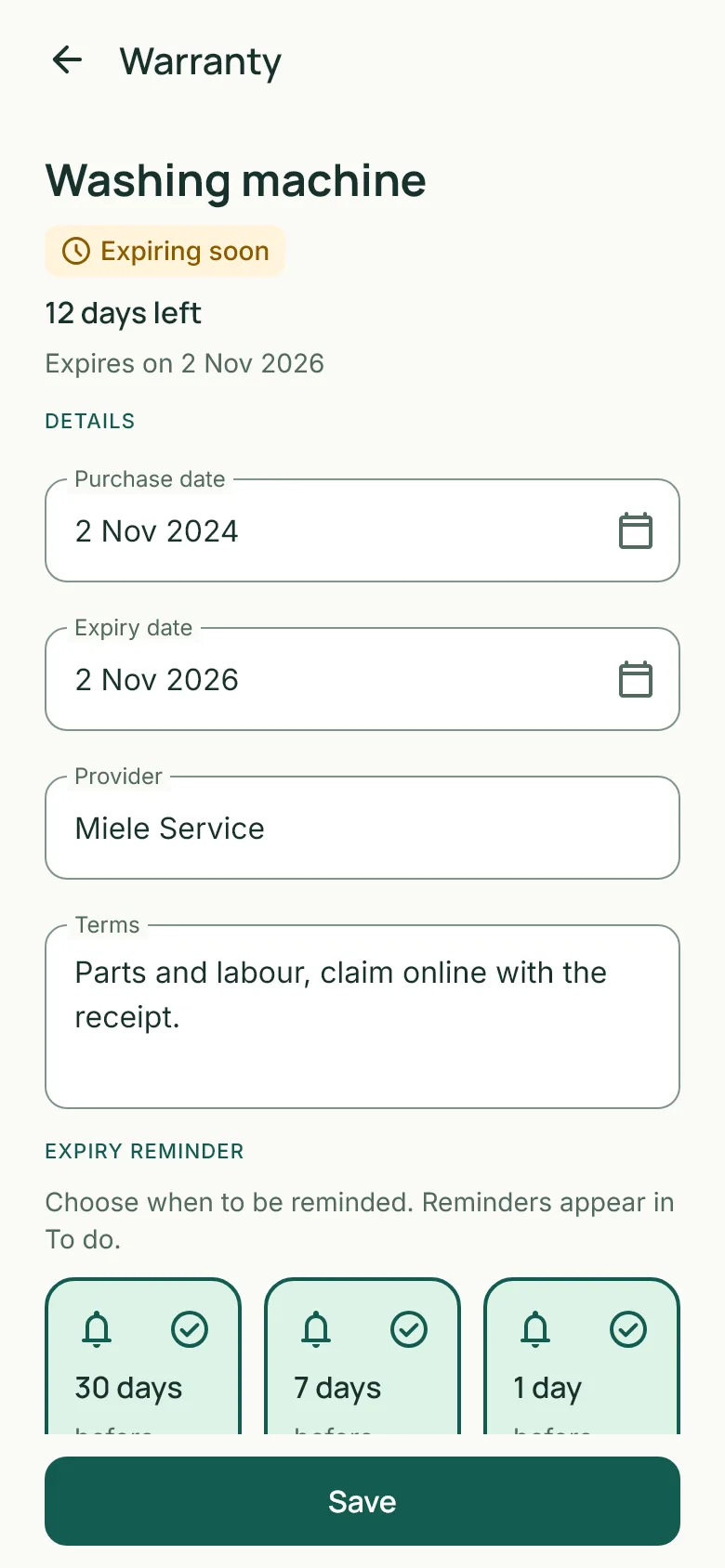
Step by step: add a warranty and get reminded
Questions
Do the two years start when I buy or when it is delivered?
When you receive the goods. For something you carry out of a shop, that is the same day.
Can the shop send me to the manufacturer?
The maker's warranty is the maker's, but the legal guarantee is the seller's. You can always go to the seller under the legal guarantee, whatever the warranty says.
Is the legal guarantee longer in Greece or Cyprus?
No: in both it is two years from delivery. In Greece, a fault that appears within one year of delivery is presumed to have been there at delivery, and your claim expires two years after delivery but never sooner than two months after you found the fault (Civil Code art. 541, 554, 555, as replaced by law 4967/2022). In Cyprus (law 154(I)/2021), tell the seller within two months of noticing the fault.
Source
European Commission, Your Europe: Guarantees and returns (the page says it was last checked on 5 October 2026; we read it on 1 November 2026).